
Galway City Council is advancing plans to replant Merlin Woods as a native woodland, creating a more resilient habitat and community amenity following the extensive damage caused by Storm Eowyn in January 2025.
The Council's plans have been informed by expert advice from an independent arborist and from Dr Colin Lawton of the University of Galway's Zoology Department, ensuring that public safety, biodiversity and the protection of the resident red squirrel population are central to the restoration proposals.
The restoration project presents a unique opportunity to create a more resilient native woodland while enhancing one of Galway City's most important natural amenities for wildlife, recreation and education. Irish Forestry Services Ireland, on behalf of Galway City Council, is preparing an application to the Department under the NeighbourWood Scheme to secure funding for the replanting works. Securing funding will depend on demonstrating local support for the replanting project and proposed amenity features, including trails, seating, signage and an outdoor classroom for schools and summer camps.
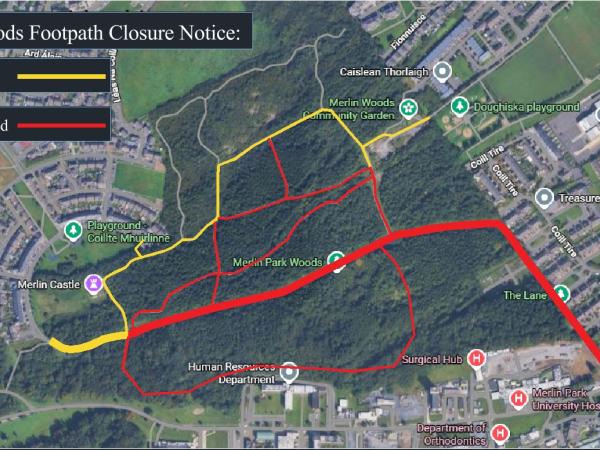
In the immediate aftermath of the storm, the Council prioritised public safety by clearing and reopening the main pedestrian routes through the park. A number of secondary pathways remain blocked by fallen trees and the Council is now focused on clearing the remaining damaged trees and progressing plans to replant the woods as a native woodland and public park.
For decades, Merlin Woods has been a mix of broadleaf and conifer trees and has been enjoyed by people and wildlife alike. Approximately 50% of the woodland is made up of Norway spruce, which were planted in the 1960s as a commercial plantation crop. The vast majority of these trees were severely damaged during Storm Eowyn.
It is worth noting that the areas least affected by Storm Eowyn are made up predominantly of native and broadleaf species, demonstrating the resilience of native woodland. Norway spruce is not a native species.
More than half of the woodland (54%) remains intact today and will be protected during the clearance works. Some standing conifers remain close to public paths, and Galway City Council sought expert advice from an independent arborist on the feasibility of retaining them. However, due to a number of factors, the clearance works will leave these trees exposed and weakened, meaning they will need to be removed for public safety reasons.
An independent arborist appointed by the Council stated; "This recommendation is a considered approach considering the topography of the site, the geology, the location in proximity to the western seaboard and tree species characteristics. I am recommending that the 3.5-hectare area is harvested and replanted with native broadleaf tree species."
At an early stage of the project, Galway City Council engaged with Dr Colin Lawton of the University of Galway's Zoology Department and author of the Irish Squirrel Survey to seek expert advice on how best to support the resident red squirrel population and inform the restoration plans.
His support for the replanting works and invaluable advice has directly influenced the harvest plan, including decisions relating to tree retention, post-harvest planting and a supplementary squirrel feeding programme, which the Council will put in place immediately. The areas of retained trees will provide continuous canopy cover for the squirrel population and other wildlife in the woods.
Commenting on the project, Dr Lawton said; "Although the loss of any forest habitat is a blow, if we can replace coniferous trees with a mix of broadleaved trees, particularly hazel, it would be beneficial to them in the long term.
We have seen the benefits of supplementary feeding for red squirrels in urban parks previously, including Belleek Forest Park in Ballina…. It could be a very good community outreach project, and volunteers/community groups could be brought in to help stock the feeders and monitor the squirrels. ”
The initial clearance works will commence in the coming weeks, and Galway City Council will continue to engage with key stakeholders.